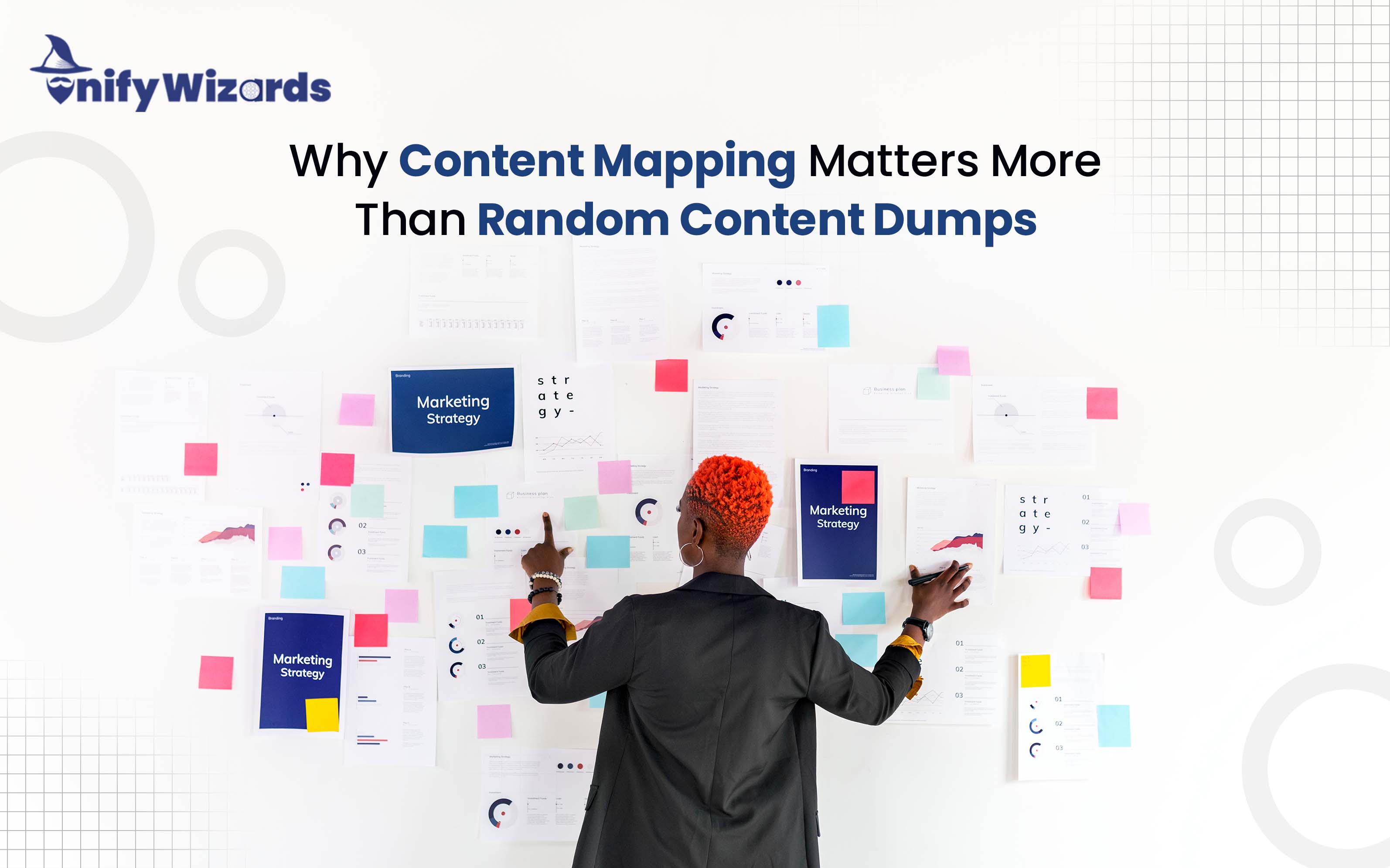
Ever landed on a website that feels like a crowded bookshelf; thousands of articles, videos, guides, but you still can’t find what you really need? That’s the problem many businesses fall into when they treat content as a volume game instead of a strategy.
Content mapping flips that script. It’s not about flooding the internet with noise, it’s about creating a path, a journey, a plan that leads your reader (and your business) somewhere meaningful.
If your content feels like scattered postcards tossed into the wind, don’t worry. Let Unify Wizards, one of the best content writing services help you build a map.
What exactly is content mapping?
At its heart, content mapping is simply drawing a map that connects who your audience is with what they need and when they need it.
It ties together:
- Personas (real or ideal readers/customers),
- Their journey from “just curious” to “ready to make a decision,”
- The content they need at each stage: informative blogs, tutorials, checklists, comparison guides, testimonials.
It helps you see what you already have, what you’re missing, and what actually helps someone move forward. Not effort for the sake of effort; but clarity, direction, and results.
Why do smart businesses don’t skip content mapping:
If we don’t sugarcoat it: dumping content without strategy rarely works. Content mapping brings real, and measurable advantages, that are:
Less chaos, more clarity: When you map out content, you know exactly what belongs where. No duplicated topics, no gap left unfilled, no confusion about who reads what.
Better user experience from day one: Readers find content that matches their needs, not random posts. These build trust and keep them coming back. Eventually, helps turn them into followers who are loyal.
Efficient use of resources: Mapping makes sure every blog post, video, or guide actually serves a purpose-not just a good intention-whether you have a full team or it's just you.
SEO & organic growth, the right way: Search engines reward structure, clarity, and user satisfaction. A content map helps you build that intentionally, not just hope for it randomly.
Easier scaling & long-term growth: As your business grows, content demands change. Content mapping keeps you adaptable. You add modules, retire outdated pages, stay relevant, especially without losing control.
How to actually build a content map?
You don’t need fancy tools or magical skills. Just a bit of planning and clarity. Here’s how to build a map that actually works:
1) Define your personas
Who reads your content? What questions keep them awake at night? What problems are they trying to solve? Know them deeply: their hopes, fears, and needs.
2) Audit what you already have
Make a list of your existing content; blogs, guides, promos. Group them by topic, stage (beginner / mid / decision), and performance.
3) Match Content to the Journey
For each persona, map out the journey; from “just discovered the problem” to “ready to buy/decide.” Assign or plan content for each stage.
4) Find the gaps & fix them
If a stage has no content, plan for it. If two pages do the same job, merge or retire. Clean up. Keep only what moves someone forward.
5) Plan formats based on intention
A how-to guide helps early in the journey. A detailed case study helps when they decide. Choose format wisely: blog, checklist, infographic, or video, based on what helps.
6) Create a live map
Visual tracking helps. You can see missing pieces, upcoming plans, duplication, and flow at a glance.
7) Revisit regularly
Markets change. Audiences change. Use the map as a living document: review every few months, update personas, retire outdated content, refresh useful posts.
Common mistakes even smart teams make:
Because content mapping isn’t glamorous work, it’s often skipped or misused. These are the pitfalls to watch for:
- Building content for “everyone” instead of specific personas
- Creating content in bursts without connection: lots of noise, zero structure
- Thinking SEO alone will solve everything; without purpose, keywords don’t help
- Forgetting to update the map; old content sticks around, relevance dies
- Chasing trends instead of asking: “Does this help our audience now?”
When content mapping feels like gardening, it grows wisely!
Think of your content ecosystem like a garden.
If you plant randomly, you get weeds.
If you plant with clarity, seeds in neat rows, water, sunlight, care, you grow vegetables that feed people.
Content mapping means tending to that garden.
Seeing where growth is sparse, which parts need pruning, which need watering.
It’s a long-term investment, slower than a viral post, but steadier, stronger, and sustainable.
Make every piece of content count!
In noisy digital landscapes, random content is static.
But a mapped content strategy builds direction, trust, and growth!
If you want to shift from “spray and pray” content efforts to something that builds weight, depth, and meaningful engagement, Unify Wizards can help you start your map.
We plot the journey, understand your people, fill in the needs, and eliminate waste. We help you grow intentionally.
When content is mapped well, the roadmap becomes clearer, not just for readers, but for your business.
When you’re ready for a clear, purposeful content strategy that evolves with your goals, reach out to Unify Wizards, we will help you.